Buyer guides · Updated 2026-11-13
Taking creatine, magnesium glycinate, omega-3 and a multivitamin together: what the research says about timing
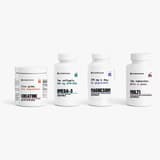
Free US shipping · Sources linked below. Or read the guide first
Short answer
Yes, for healthy adults. We found no trial that tested these four taken together versus apart, and the spacing rules we found on drug labels and NIH fact sheets are about medicines, not about these four with each other. What the research does support: take the omega-3 and the multivitamin with a meal that has some fat, because fat helps the body absorb EPA, DHA and vitamins A, D and E; take creatine whenever you will remember it, because three trials found the same gains before or after training; and keep all magnesium from supplements under 350 mg a day (Foundation gives 325 mg). Our grades for each one: creatine A (strength and lean mass with resistance training), omega-3 B (overall evidence), magnesium glycinate C (relaxation and sleep quality), multivitamin C (filling nutrient gaps). Grades rate the research on the molecule, not our product.
Our grade: Each row carries its own grade, read from our published science summaries
CC Small or few human trials. Promising, not proven. How we grade → 1. Creatine: any time of day
Three randomized trials found the same gains whether creatine was taken right before or right after training: 22 older adults over 12 weeks (Candow 2014), 10 young adults over 8 weeks (Forbes 2021) and 34 collegiate athletes over 8 weeks (Dinan 2022). The one trial that leaned toward after training, 19 men over 4 weeks, found no statistically significant difference (Antonio 2013). None compared morning with evening. Taking it with a meal that has some carbohydrate and protein may help the body keep a little more, but that was shown during loading, not for muscle results, and there is no need to add sugar. One 5 g scoop a day fills muscle stores in about 3 to 4 weeks; loading at about 20 g a day for 5 to 7 days is optional (Kreider 2017). Coffee: two small lab studies found that daily high-dose caffeine during a high-dose loading week canceled creatine's effect, but a larger trial in 54 men and two systematic reviews do not show a consistent clash, and no trial has tested an ordinary coffee habit with 3 to 5 g a day and no loading.
BB Good human data, but mixed outcomes or surrogate markers. How we grade → 2. Omega-3: with a meal that contains fat
In single-dose studies, fat in the meal raised how much EPA and DHA the body absorbed. With a high-fat meal (44 g of fat), EPA absorption from triglyceride fish oil rose from 69% to 90%, and absorption from ethyl esters roughly tripled, to about 60% (Lawson and Hughes 1988). These studies are small and measured blood levels, not health. Our label: 1 softgel twice a day with meals, 600 mg of EPA plus DHA from the 2 softgels, $24.90 for 50 days, about $0.50 a day.
CC Small or few human trials. Promising, not proven. How we grade → 3. Multivitamin: 2 capsules with a meal
Vitamins A (as beta-carotene), D and E dissolve in fat. In a randomized single-dose study in 50 older adults, a vitamin D3 pill taken with a meal containing fat gave a 32% higher peak in the blood than the same pill with a fat-free meal (Dawson-Hughes 2015). About 3 g of fat was as good as 36 g for vitamin E and beta-carotene (Roodenburg 2000), so a modest amount of fat is enough. These studies used large single doses and measured blood levels, not health. No trial has compared morning with evening for a multivitamin. Our label says 2 capsules in the morning with a meal; if you skip breakfast, take them with your first meal of the day that has some fat (our suggestion). Do not add a second multivitamin.
CC Small or few human trials. Promising, not proven. How we grade → 4. Magnesium glycinate: once a day, and count every source
Our label says 3 capsules once a day, for example in the evening: 275 mg of elemental magnesium from 2,500 mg of magnesium glycinate, $26.90 for 30 days. No trial has compared times of day. The adult upper limit for magnesium from supplements and medicines is 350 mg a day; food does not count. Our multivitamin adds 50 mg as oxide, so the two together give 325 mg, under the limit, and its 400 IU of vitamin D3 is well under the 4,000 IU limit. We found no trial comparing magnesium and vitamin D taken at the same time with the two taken apart. Do not add another magnesium supplement, antacid or laxative without asking a clinician. Diarrhea, nausea or cramps are the usual sign of too much; if your stomach is sensitive, split the dose across the day.
5. A simple day (our suggestion, not a tested schedule)
With breakfast or your first meal that has some fat: 2 multivitamin capsules, 1 omega-3 softgel and 1 scoop of creatine in 8 oz of water or juice. With dinner: 1 omega-3 softgel and 3 magnesium glycinate capsules. If you train, creatine before or after the session works just as well. That is 7 capsules or softgels and one scoop a day. Foundation, $69.00: 30 days of all four; the creatine and omega-3 last about 50 days each.
6. Medicines to space apart, and who should ask first
Levothyroxine: keep taking it as prescribed, on an empty stomach, and take the multivitamin with a later meal at least 4 hours apart (our suggestion, based on the Synthroid label, which names calcium and iron). Our multivitamin has 300 mcg of biotin; before a thyroid blood test, tell your clinician, since that label says to stop biotin-containing supplements 2 days before. Quinolone or tetracycline antibiotics: take them at least 2 hours before or 4 to 6 hours after the multivitamin and the magnesium, or follow your pharmacist's timing. Alendronate or another bisphosphonate: take it first thing with plain water as its label says, and the capsules with food at least 2 hours later. Blood thinners such as warfarin: ask first, since fish oil can have antiplatelet effects at high doses. Also ask first if you have kidney disease, atrial fibrillation or a fish allergy, or are pregnant or breastfeeding. For adults 18 and older.
Questions
Can I take creatine and magnesium at the same time?
Yes. Neither of our labels says to keep them apart, and we found no trial comparing the two taken together versus apart. Creatine timing makes little difference in the trials, so taking both in the evening, as the magnesium label suggests, is fine.
Can I take fish oil and a multivitamin together?
Yes, and the same meal is a good fit: both are absorbed better with some fat. Do not add a second multivitamin or extra vitamin D without counting the totals.
Should I take creatine in the morning or at night?
Either. Three trials found the same gains before or after training, and none compared morning with evening. Pick the time you will not forget.
Can I take them on an empty stomach?
Creatine and magnesium, yes; if magnesium upsets your stomach, split the dose across the day. The omega-3 and the multivitamin are better absorbed with a meal that has some fat.
Does coffee cancel creatine?
Probably not at ordinary intake. The clash showed up in two small lab studies of high-dose caffeine during a high-dose creatine loading week; a larger trial and two reviews did not find a consistent clash, and no trial has tested ordinary coffee with 3 to 5 g of creatine a day.
Does Foundation go over any upper limit?
No. Magnesium from the multivitamin and the magnesium glycinate totals 325 mg against a 350 mg limit, and vitamin D is 400 IU against 4,000 IU. Count any other supplements, antacids, laxatives or fortified foods you use on top.
Not ready to buy yet?
A short email when there is something worth saying: the evidence we have graded, label changes, and new batches.
Sources (each DOI or PMID checked on Crossref or PubMed, 25 Oct 2026)
- Candow DG et al. Res Sports Med. 2014;22(1):61-74. Before vs after training, 22 older adults, 12 weeks.
- Forbes SC, Krentz JR, Candow DG. J Sports Med Phys Fitness. 2021;61(9):1219-1225. Before vs after, within-subject, 10 young adults.
- Dinan NE et al. Front Sports Act Living. 2022;4:1033842. Timing, 34 collegiate athletes, 8 weeks, placebo-controlled.
- Antonio J, Ciccone V. J Int Soc Sports Nutr. 2013;10:36. Creatine before vs after training, 19 men, 4 weeks.
- Steenge GR, Simpson EJ, Greenhaff PL. J Appl Physiol. 2000;89(3):1165-1171. Protein and carbohydrate and creatine retention.
- Kreider RB et al. J Int Soc Sports Nutr. 2017;14:18. ISSN position stand on creatine.
- Vandenberghe K et al. J Appl Physiol. 1996;80(2):452-457. Caffeine and creatine loading, 9 men.
- Trexler ET et al. J Strength Cond Res. 2016;30(5):1438-1446. Coffee and caffeine during creatine loading, 54 men.
- Lawson LD, Hughes BG. Biochem Biophys Res Commun. 1988;156(2):960-963. Fish oil absorption with a high-fat meal. PMID 2847723.
- Dawson-Hughes B et al. J Acad Nutr Diet. 2015;115(2):225-230. Vitamin D3 with a fat-containing vs fat-free meal, 50 older adults.
- Roodenburg AJ et al. Am J Clin Nutr. 2000;71(5):1187-1193. 3 g vs 36 g of fat: vitamin E, carotenes and lutein.
- NIH Office of Dietary Supplements. Multivitamin/mineral supplements fact sheet for health professionals.
- NIH Office of Dietary Supplements. Magnesium fact sheet for health professionals.
- NIH Office of Dietary Supplements. Omega-3 Fatty Acids fact sheet for health professionals.
- Synthroid (levothyroxine) FDA label on DailyMed: empty stomach, 4 hours from calcium carbonate and iron, stop biotin 2 days before thyroid tests.
Read next
- Full summary: multivitamin timing and absorption
- Creatine timing, loading, food and coffee
- When to take creatine
- Foundation: all four basics
- All buyer guides
* These statements have not been evaluated by the Food and Drug Administration. This product is not intended to diagnose, treat, cure, or prevent any disease.