Buyer guides · Updated 2026-10-30
Creatine monohydrate benefits: which ones the trials support, and which they do not
Free US shipping · Sources linked below. Or read the guide first
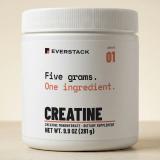
Want the free creatine tub? It comes with Foundation, our 30-day box of creatine, omega-3, magnesium glycinate and the multivitamin: $69 (the four bought separately: $112.60). Code FIRST100 is added for you, first 100 Foundation orders, one per customer.
Buy Foundation, $69Short answer
The benefit with the strongest evidence is more muscle strength and lean mass when you combine creatine monohydrate with resistance training: grade A. Across 22 randomized trials in 721 older adults who trained, creatine added about 1.4 kg more lean mass than training with a placebo. A few other benefits have some support: repeated short sprints (grade B), lean mass and strength in older adults (grade B), and muscle creatine stores in people who eat little or no meat (grade B). Memory and bone are not established. Below is each benefit people mention, with its own grade, so you can see where the evidence is strong and where it is thin. Grades rate the research on the molecule, not our product.
AA Multiple randomized trials or meta-analyses, consistent results. How we grade → Our grade: Creatine monohydrate: muscle strength and lean mass, with resistance training
AA Multiple randomized trials or meta-analyses, consistent results. How we grade → 1. Strength and lean mass, with resistance training
This is the benefit on our label and the one with the most trials. Creatine helps muscles do a little more work during hard sets, and over weeks of training that adds up. In a pooled analysis of 22 randomized trials (721 adults), creatine with resistance training added about 1.4 kg more lean mass and more strength than the same training with a placebo. Other pooled analyses agree. Training is the active ingredient: in postmenopausal women, trials without training, or at 3 g a day or less, found no measurable effect.
BB Good human data, but mixed outcomes or surrogate markers. How we grade → 2. Older adults: lean mass and strength
Looked at as a separate claim for older adults, the support is good but less even. A 2014 meta-analysis of 357 older adults found more fat-free mass, stronger chest and leg press, and a better 30 second chair stand. A 2025 meta-analysis of 8 trials (482 people) found small gains in lean mass and leg strength, no overall gain in upper body strength, and a weaker signal after 32 weeks.
BB Good human data, but mixed outcomes or surrogate markers. How we grade → 3. Repeated short sprints
A 2022 meta-analysis of 14 trials found higher mean power during repeated sprints after 3 to 7 days at about 20 g a day, with no clear change in peak power or fatigue. An earlier meta-analysis found small benefits for very short efforts and no benefit for running or swimming. So the result is real for repeated sprint tests and uneven elsewhere.
BB Good human data, but mixed outcomes or surrogate markers. How we grade → 4. People who eat little or no meat
Meat and fish supply most dietary creatine, so vegetarians start lower. In one trial they began at about 117 mmol per kg of muscle versus 130 in meat eaters, and the rise after creatine was larger in the vegetarian group. A review of 9 studies found the same muscle pattern, with moderate to high risk of bias.
CC Small or few human trials. Promising, not proven. How we grade → 5. Memory and thinking: not established
Brain creatine rises less than muscle creatine, mostly at high doses. Effects on thinking are small and inconsistent, two memory meta-analyses were criticized for double counting, and in 2024 Europe's food safety regulator (EFSA) said a cause and effect link has not been established. We make no memory claim for our product.
CC Small or few human trials. Promising, not proven. How we grade → 6. Thinking during sleep loss: early
Two small trials found that 5 g four times a day for 7 days lessened the drop on some complex thinking tasks after sleep loss, but not every test improved; in one trial the groups were 10 and 9 adults. A later trial found that a single dose of 0.35 g per kg improved thinking speed during about 21 hours without sleep. These studies are few and small.
DD Mostly mechanistic or early data. Shown openly. How we grade → 7. Bone density: not supported
A 2018 meta-analysis of 5 trials (193 older adults) found no extra bone mineral density at the whole body, hip, femoral neck or lumbar spine when creatine was added to resistance training. A 2025 meta-analysis also found no clear effect on total body bone density. One 12 month trial in postmenopausal women found less femoral neck loss, but that single result has not held in the pooled trials.
AA Multiple randomized trials or meta-analyses, consistent results. How we grade → How to take it, and who should check first
Take 3 to 5 g of plain creatine monohydrate once a day, rest days included, at any time you will remember. Loading with about 20 g a day for 5 to 7 days fills muscle stores faster but is optional; a daily dose gets there in about 3 to 4 weeks. In randomized trials creatine raised blood creatinine slightly (about 0.13 mg/dL) without changing estimated kidney filtration, so tell whoever orders your blood tests that you take it. Talk to a clinician first if you have kidney disease, are pregnant or breastfeeding, or take medicines that affect the kidneys. For adults 18 and older. Ours is $27.90 for a 281 g tub, about $0.56 a day at 5 g.
Questions
What are the benefits of creatine monohydrate?
The best supported benefit is more muscle strength and lean mass with resistance training (grade A). Repeated short sprints (grade B), older adults (grade B) and people who eat little meat (grade B) have some support. Memory is not established and bone density is not supported.
Does creatine work if I do not exercise?
The strength and lean mass benefit shows up with resistance training. In postmenopausal women, pooled trials without training found no measurable effect.
How long does creatine take to work?
At 3 to 5 g a day, muscle stores fill in about 3 to 4 weeks; loading at about 20 g a day gets there in about a week. Strength gains then build over weeks of training.
Does creatine help the brain?
Not established. We grade memory and thinking C and make no brain claim for our product.
Not ready to buy yet?
A short email when there is something worth saying: the evidence we have graded, label changes, and new batches.
Sources (each DOI or PMID checked on Crossref or PubMed, 25 Oct 2026)
- Chilibeck PD et al. Open Access J Sports Med. 2017;8:213-226. Creatine with resistance training in older adults, 22 trials. PMID 29138605.
- Devries MC, Phillips SM. Med Sci Sports Exerc. 2014;46(6):1194-1203. Creatine with resistance training in older adults, meta-analysis, 357 adults.
- Liu S et al. Eur Rev Aging Phys Act. 2025;22(1):26. Creatine with resistance training in older adults, meta-analysis of 8 trials, 482 people.
- Glaister M, Rhodes L. Int J Sport Nutr Exerc Metab. 2022;32(6):491-500. Short-term creatine and repeated sprint ability, meta-analysis.
- Branch JD. Int J Sport Nutr Exerc Metab. 2003;13(2):198-226. Creatine, body composition and performance, meta-analysis.
- Burke DG et al. Med Sci Sports Exerc. 2003;35(11):1946-1955. Creatine and weight training in vegetarians and meat eaters, 42 adults, 8 weeks.
- Kaviani M, Shaw K, Chilibeck PD. Int J Environ Res Public Health. 2020;17(9):3041. Creatine in vegetarians vs omnivores, systematic review.
- Dechent P et al. Am J Physiol Regul Integr Comp Physiol. 1999;277(3):R698-R704. Brain creatine after oral creatine monohydrate.
- McMorris T et al. Psychopharmacology. 2006;185(1):93-103. Creatine and sleep deprivation, cognitive performance.
- McMorris T et al. Physiol Behav. 2007;90(1):21-28. Creatine, sleep deprivation and behavior.
- Gordji-Nejad A et al. Sci Rep. 2024;14(1):4937. Single dose creatine during sleep deprivation.
- Forbes SC et al. Front Nutr. 2018;5:27. Creatine with resistance training and bone density in older adults, meta-analysis of 5 trials.
- Sharifian G et al. Eur Rev Aging Phys Act. 2025;22(1):17. Creatine and exercise training in older adults, meta-analysis.
- Naddafha S et al. J Int Soc Sports Nutr. 2026;23(1):2668435. Creatine in postmenopausal women, meta-analysis of 7 trials, 608 women.
- Hultman E et al. J Appl Physiol. 1996;81(1):232-237. Muscle creatine loading, 20 g vs 3 g a day.
- Kreider RB et al. J Int Soc Sports Nutr. 2017;14:18. ISSN position stand on creatine.
- Tsiaras A et al. J Ren Nutr. 2026. Creatine and kidney function, meta-analysis of randomized trials.
Read next
- Every claim we grade, with sources
- Best creatine monohydrate: how we graded it
- When to take creatine
- Our full creatine evidence page
- All buyer guides
* These statements have not been evaluated by the Food and Drug Administration. This product is not intended to diagnose, treat, cure, or prevent any disease.