Buyer guides · Updated 2026-11-21
How much protein per meal? What the lab studies and the trials actually show
Free US shipping · Sources linked below. Or read the guide first
Short answer
There is no proven limit of 20 or 30 g per meal. That idea comes from short lab studies in young men that measured muscle protein synthesis (how fast muscle builds new protein) for a few hours after exercise: 20 g looked like enough after leg training, 40 g did a little more after a full-body session, and in a 2023 study 100 g of milk protein gave a bigger and longer response than 25 g over 12 hours, with no clear upper limit. What the long-term trials show most clearly is the daily total: with resistance training, gains in lean mass stopped rising at about 1.6 g of protein per kg of body weight a day, about 120 g for a 75 kg adult, from all food. A practical pattern is 3 or 4 meals of about 0.25 to 0.4 g per kg each, roughly 20 to 40 g for most adults. Food protein counts the same as a shake. Our summary of protein dose and timing gets grade B, because the per-meal answers rest on short lab studies; daily protein with training is graded A in our table.
BB Good human data, but mixed outcomes or surrogate markers. How we grade → Our grade: Whey protein: how much a day, how much per shake, and whether timing matters
1. Where the 20 to 30 g idea comes from
In Moore 2009, 6 young men were given 0, 5, 10, 20 or 40 g of egg protein after leg exercise. Muscle protein synthesis rose with the dose and peaked at 20 g; going to 40 g mainly raised the amount of protein burned for energy. In Witard 2014, 48 resistance-trained young men weighing about 80 kg got 0, 10, 20 or 40 g of whey protein isolate after leg exercise: 20 g raised muscle protein synthesis by 49% and 40 g by 56% compared with no protein, and 40 g also raised amino acid burning, so the authors concluded 20 g was enough after leg exercise. These studies measured a lab marker over a few hours, not muscle growth over months.
2. Bigger sessions and bigger meals: the newer studies
After whole-body exercise, 40 g of whey gave about 20% more muscle protein synthesis than 20 g in 30 resistance-trained young men, whether they had more or less lean mass (Macnaughton 2016). In Trommelen 2023, 36 young men got 0, 25 or 100 g of milk protein after exercise and were followed for 12 hours: 100 g gave a larger response than 25 g that lasted more than 12 hours, with little extra burned for energy, and the authors concluded the response to a protein meal has no clear upper limit in size or duration. Limits: one 12-hour window, young men only, and the study did not test whether one very large meal builds more muscle over months than several smaller ones. One author works for a dairy company, which the paper says had no role in funding or analysis.
3. Spreading it out: 4 servings beat 2 big ones or 8 small ones
In Areta 2013, 24 trained men took 80 g of whey over 12 hours in three patterns. Four 20 g doses every 3 hours gave 31% to 48% more muscle protein synthesis than eight 10 g doses or two 40 g doses. The ISSN position stand suggests about 0.25 g per kg, or 20 to 40 g, per serving, spread every 3 to 4 hours (Jäger 2017), and a 2018 review suggests about 0.4 g per kg per meal over at least four meals, up to about 0.55 g per kg for someone aiming at 2.2 g per kg a day (Schoenfeld and Aragon 2018). For a 75 kg adult, 0.4 g per kg is 30 g a meal.
4. The daily total matters most
In a meta-analysis of 49 randomized trials with 1,863 people, protein added to resistance training for about 13 weeks on average gave about 2.49 kg more one-repetition maximum strength and about 0.30 kg more fat-free mass than training without it, and gains in fat-free mass stopped rising at about 1.62 g per kg a day (95% CI 1.03 to 2.20); because the interval is wide, the authors suggest about 2.2 g per kg for people who want to be sure (Morton 2018). The effects are modest and were larger in people who already trained. Timing around the workout made no clear difference once total protein was accounted for (Schoenfeld 2013). So have a shake whenever it best helps you reach your total.
5. Older adults, kidneys and milk: who should ask first
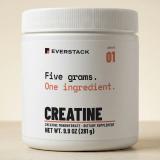
Older men needed about 0.40 g per kg in one meal to reach the highest muscle protein synthesis, against about 0.24 g per kg for young men (Moore 2015), so older adults may need more per meal. In adults without kidney disease, higher-protein diets did not change kidney filtration over time in a meta-analysis of 28 trials (Devries 2018). If you have kidney disease or reduced kidney function, ask your clinician or a renal dietitian for your own target before adding any protein supplement, because the usual advice is less protein, not more. Whey is a milk protein: do not use it if you have a milk allergy. Pregnant or breastfeeding, under 18, or a medical condition: ask your clinician first. Our Whey Protein Isolate, Vanilla gives 19 g of protein per scoop, 28 scoops for $59.90, and is sold only as an add-on to another order. If you train, creatine monohydrate is the other basic we sell for it: it supports muscle strength with resistance training (graded A).
Questions
Can your body only absorb 30 g of protein at once?
No. The 20 to 30 g idea is about how much protein short lab studies saw used for muscle building in the few hours after exercise, not a measure of how much you absorb. A 2023 study found 100 g gave a bigger and longer response than 25 g, with no clear upper limit.
How much protein per meal should I aim for?
About 0.25 to 0.4 g per kg of body weight per meal, over 3 or 4 meals, which is roughly 20 to 40 g for most adults. Older adults may need the higher end.
How much protein a day if I lift weights?
In a meta-analysis of 49 trials, extra lean mass stopped growing at about 1.6 g per kg a day, about 120 g for a 75 kg adult, counting all food. Up to about 2.2 g per kg if you want to be sure.
Do I need a protein shake right after training?
No. Once total daily protein was accounted for, protein taken around the workout made no clear difference to muscle size or strength. Food counts the same as a shake.
Not ready to buy yet?
A short email when there is something worth saying: the evidence we have graded, label changes, and new batches.
Sources (each DOI or PMID checked on Crossref or PubMed, 25 Oct 2026)
- Moore DR et al. Am J Clin Nutr. 2009;89(1):161-168. 0 to 40 g egg protein after exercise.
- Witard OC et al. Am J Clin Nutr. 2014;99(1):86-95. 0 to 40 g whey isolate after exercise.
- Macnaughton LS et al. Physiol Rep. 2016;4(15):e12893. 40 g vs 20 g whey after whole-body exercise.
- Trommelen J et al. Cell Rep Med. 2023;4(12):101324. 100 g vs 25 g milk protein over 12 hours, no clear upper limit.
- Areta JL et al. J Physiol. 2013;591(9):2319-2331. 80 g whey over 12 hours in three patterns.
- Jäger R et al. J Int Soc Sports Nutr. 2017;14:20. ISSN position stand on protein and exercise.
- Schoenfeld BJ, Aragon AA. J Int Soc Sports Nutr. 2018;15:10. How much protein one meal can use for muscle building.
- Morton RW et al. Br J Sports Med. 2018;52(6):376-384. Protein supplementation with resistance training, meta-analysis of 49 RCTs.
- Schoenfeld BJ, Aragon AA, Krieger JW. J Int Soc Sports Nutr. 2013;10:53. Protein timing meta-analysis.
- Moore DR et al. J Gerontol A Biol Sci Med Sci. 2015;70(1):57-62. Protein per meal, older vs younger men.
- Devries MC et al. J Nutr. 2018;148(11):1760-1775. Higher protein and kidney function, meta-analysis of 28 trials.
Read next
- Full summary: whey protein dose, per shake and timing
- Paper: 100 g vs 25 g of protein over 12 hours (Trommelen 2023)
- Paper: how much protein one meal can use (Schoenfeld and Aragon 2018)
- Protein after 65: daily targets
- Our Whey Protein Isolate, Vanilla (add-on)
- All buyer guides
* These statements have not been evaluated by the Food and Drug Administration. This product is not intended to diagnose, treat, cure, or prevent any disease.