Buyer guides · Updated 2026-11-02
Multivitamin benefits: which ones the trials support, and which they do not
Free US shipping · Sources linked below. Or read the guide first
Short answer
The benefit with the most support is filling common nutrient gaps: grade C. A daily multivitamin reliably raises your intake of nutrients many diets fall short on; in US survey data on 10,698 adults, people who used supplements had fewer inadequate intakes than with food alone. Two newer findings, both from one large trial in adults over 60 (COSMOS), are early: a small memory benefit (grade C) and slightly slower readings on some epigenetic aging clocks (grade C). Living longer is not supported (grade D): in an 11-year trial of 14,641 male doctors and in cohorts of 390,124 US adults, daily users did not live longer. Below is each benefit people mention, with its own grade. Grades rate the research on the molecule, not our product.
CC Small or few human trials. Promising, not proven. How we grade → Our grade: Daily multivitamin: filling common nutrient gaps (the use on our label)
CC Small or few human trials. Promising, not proven. How we grade → 1. Filling common nutrient gaps
This is the use on our label. A multivitamin raises your intake of the vitamins and minerals it contains, and many diets fall short on some of them. In 10,698 US adults (NHANES 2009 to 2012), supplement use plus food was linked to fewer inadequate intakes than food alone, with the largest effect in adults 71 and older; the authors disclosed consulting for a supplement industry group. What it does not show: large trials have not found that filling gaps this way prevents heart attacks or strokes, and the US Preventive Services Task Force found too little evidence to recommend a multivitamin to prevent disease. That is why this grade is C.
CC Small or few human trials. Promising, not proven. How we grade → 2. Memory in older adults: early
Three cognition substudies of one large trial (COSMOS, adults over 60) found a small memory benefit after 2 to 3 years. All three come from the same parent trial, the multivitamin was donated by its maker, and no separate trial has repeated the result. We make no memory claim for our product.
CC Small or few human trials. Promising, not proven. How we grade → 3. Epigenetic aging clocks: early
In one prespecified COSMOS substudy, 958 older adults took a daily multivitamin or placebo for 2 years. Two clocks moved a little: PCGrimAge slowed by 0.113 years per year and PCPhenoAge by 0.214 years per year. The authors called the effects small and said more studies are needed before the clinical meaning is clear, and a 2024 review found trials of specific nutrients on these clocks were scarce. A clock reading is a lab measure, not proof of a longer or healthier life. We make no aging claim for our product.
DD Mostly mechanistic or early data. Shown openly. How we grade → 4. Living longer: not supported
In an 11-year randomized trial of 14,641 male doctors (Physicians' Health Study II), a daily multivitamin did not lower death from any cause. In cohorts of 390,124 US adults followed for about 20 years, regular users did not live longer than non-users. We do not claim that a multivitamin helps you live longer.
How to take it, and who should check first
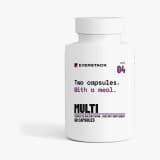
Take it with a meal: vitamins A, D and E dissolve in fat, and food can soften the niacin flush some people notice. Do not combine two multivitamins, and count fortified foods, because extra vitamin A, zinc and niacin can go over safe upper limits. Ours is 2 capsules in the morning with 400 IU of vitamin D3 and 50 mg of magnesium, with no iron, vitamin K or iodine; it also has small herbal blends, and we make no claims for the herbs. Ask a clinician first if you take a blood thinner or aspirin (the blend includes garlic), if you smoke or used to (vitamin A comes as beta-carotene), or if you are pregnant or breastfeeding. For adults 18 and older. Ours is $32.90 for 30 days, about $1.10 a day.
Questions
What are the benefits of taking a multivitamin?
It helps fill common nutrient gaps (grade C). A small memory benefit in older adults (grade C) and slightly slower epigenetic aging clocks (grade C) are early findings from one trial. Living longer is not supported (grade D).
Does a multivitamin help memory?
Three substudies of one trial in adults over 60 found a small benefit after 2 to 3 years, and no separate trial has repeated it. Our grade is C, and we make no memory claim for our product.
Do multivitamins slow aging?
One 2-year substudy found small changes on two epigenetic clocks (grade C), and trials found no longer life (grade D). A clock reading is not proof of a longer life.
Who is most likely to benefit from a multivitamin?
People whose food falls short: those who eat little or a narrow diet, and older adults. If you eat a varied diet, it adds less.
Not ready to buy yet?
A short email when there is something worth saying: the evidence we have graded, label changes, and new batches.
Sources (each DOI or PMID checked on Crossref or PubMed, 25 Oct 2026)
- NIH Office of Dietary Supplements. Multivitamin/mineral supplements fact sheet for health professionals.
- Blumberg JB et al. Nutrients. 2017;9(12):1325. Supplements and nutrient adequacy in 10,698 US adults (NHANES). PMID 29211007.
- US Preventive Services Task Force. JAMA. 2022;327(23):2326-2333.
- Baker LD et al. Alzheimers Dement. 2023;19(4):1308-1319. COSMOS-Mind, cocoa extract and a multivitamin on cognition.
- Yeung LK et al. Am J Clin Nutr. 2023;118(1):273-282. COSMOS-Web, multivitamin and memory in older adults.
- Vyas CM et al. Am J Clin Nutr. 2024;119(3):692-701. COSMOS-Clinic and pooled analysis of the three cognition substudies.
- Li S et al. Nat Med. 2026;32(3):1012-1022. COSMOS substudy, multivitamin and cocoa extract on epigenetic aging clocks, 958 older adults.
- García-García I et al. Front Aging. 2024;5:1417625. Nutrition and epigenetic clocks, systematic review of clinical trials.
- Gaziano JM et al. JAMA. 2012;308(18):1871-1880. Physicians' Health Study II, 14,641 male doctors, daily multivitamin for about 11 years.
- Loftfield E et al. JAMA Netw Open. 2024;7(6):e2418729. Multivitamin use and mortality, 3 US cohorts.
Read next
- Every claim we grade, with sources
- Is a multivitamin worth it?
- Full summary: the large multivitamin trials
- What is in our multivitamin label
- All buyer guides
* These statements have not been evaluated by the Food and Drug Administration. This product is not intended to diagnose, treat, cure, or prevent any disease.