Buyer guides · Updated 2026-10-25
Omega-3 dose: how much EPA and DHA do you actually need?
Free US shipping · Sources linked below. Or read the guide first
Short answer
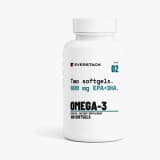
There is no official US daily requirement for EPA and DHA. The European Food Safety Authority uses 250 mg a day of EPA plus DHA as a reference for adults, and US adults get only about 90 mg a day from food. One or two servings of oily fish a week, what the American Heart Association suggests, gets most people there. If you rarely eat fish, a supplement that gives a few hundred milligrams of EPA plus DHA a day raises your levels; ours gives 600 mg in 2 softgels. Read the label for EPA plus DHA, not fish oil. Our grade is B, for omega-3 status.
BB Good human data, but mixed outcomes or surrogate markers. How we grade → Our grade: Omega-3 (EPA and DHA) status
Read EPA plus DHA, not fish oil
A typical 1,000 mg fish oil softgel has 180 mg EPA and 120 mg DHA, 300 mg combined. Ours matches that: 2 softgels give 360 mg EPA and 240 mg DHA, 600 mg a day, for 50 days a bottle.
How much is enough
No expert body has set a US requirement for EPA or DHA; the only US intake value is for ALA, the plant omega-3. EFSA's 250 mg a day is a reasonable floor. The large VITAL trial used 840 mg a day (460 mg EPA, 380 mg DHA). An Omega-3 Index blood test shows how much EPA and DHA is in your red blood cells, about 3% to 5% in Western populations who eat little fish.
More is not better
FDA asks supplement labels not to recommend more than 2 g of EPA plus DHA a day, and considers up to 5 g a day safe. Across 7 trials, omega-3 supplements were linked to a higher risk of atrial fibrillation, more so at doses above 1 g a day. High doses are a medical decision, not a supplement dose.
Take it with a meal
Omega-3s are absorbed best with a meal that contains some fat. People taking warfarin or similar blood thinners, and anyone with a fish allergy, should ask a clinician first.
Questions
How much omega-3 should I take a day?
There is no US requirement. 250 mg of EPA plus DHA a day is a common reference for adults; a few hundred milligrams from fish or a supplement covers it. Stay at or under 1 g a day unless a clinician advises more.
Is 1,000 mg of fish oil enough?
A 1,000 mg softgel usually has about 300 mg of EPA plus DHA. Check the label: the EPA plus DHA number is what counts.
Should I take omega-3 with food?
Yes. Absorption is best with a meal that contains some fat.
Not ready to buy yet?
A short email when there is something worth saying: the evidence we have graded, label changes, and new batches.
Sources (each DOI or PMID checked on Crossref or PubMed, 25 Oct 2026)
- NIH Office of Dietary Supplements. Omega-3 Fatty Acids fact sheet for health professionals.
- Manson JE et al. N Engl J Med. 2019;380(1):23-32. VITAL, 1 g omega-3 a day.
- Gencer B et al. Circulation. 2021;144(25):1981-1990. Omega-3 dose and atrial fibrillation, 7 trials.
- Harris WS, von Schacky C. Prev Med. 2004;39(1):212-220. The Omega-3 Index.
- Lawson LD, Hughes BG. Biochem Biophys Res Commun. 1988;156(2):960-963. Fish oil absorption with a high-fat meal. PMID 2847723.
Read next
* These statements have not been evaluated by the Food and Drug Administration. This product is not intended to diagnose, treat, cure, or prevent any disease.