Buyer guides · Updated 2026-11-09
Creatine for older adults: muscle, strength, bone and safety, checked against the trials
Free US shipping · Sources linked below. Or read the guide first
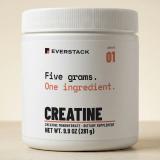
Want the free creatine tub? It comes with Foundation, our 30-day box of creatine, omega-3, magnesium glycinate and the multivitamin: $69 (the four bought separately: $112.60). Code FIRST100 is added for you, first 100 Foundation orders, one per customer.
Buy Foundation, $69Short answer
If you are over 60 and lift weights, or are willing to start, creatine monohydrate is one of the few supplements with real trial support for you. We grade lean mass and strength in older adults B: across 22 randomized trials in 721 adults with mean ages of about 57 to 70, adding creatine to resistance training gave about 1.4 kg more lean mass and small strength gains compared with training plus a placebo. The gains are smaller and less even than in younger lifters, and they depend on the training. Bone density is not supported (grade D) and memory is not established (grade C). The usual dose is 3 to 5 g a day; check with your clinician first if you have kidney disease or take medicines that affect the kidneys.
BB Good human data, but mixed outcomes or surrogate markers. How we grade → Our grade: Creatine monohydrate: lean mass and strength in older adults, with resistance training
BB Good human data, but mixed outcomes or surrogate markers. How we grade → 1. Lean mass and strength: what the pooled trials found
A 2017 meta-analysis of 22 trials (721 adults, mean ages about 57 to 70) found about 1.4 kg more lean mass and small strength gains when creatine was added to resistance training. A 2014 meta-analysis of 357 older adults also found more fat-free mass, a stronger chest and leg press, and a better 30 second chair stand, a simple test of getting up from a chair. A 2025 meta-analysis of 8 trials (482 people) was more cautious: small gains in lean mass and leg strength, no overall gain in upper body strength, and a weaker signal in trials longer than 32 weeks. That mix is why we grade this one step below our grade for creatine in general.
2. Training is the active ingredient
Creatine helps muscles do a little more work during each set, so the benefit shows up with resistance exercise, not instead of it. The trials used weights, machines or bands, usually two or three sessions a week. If you are not training yet, starting is the bigger win, and creatine is a small, low-cost add-on to it. Ask your clinician which kind of exercise suits you if you have heart, joint or balance problems.
DD Mostly mechanistic or early data. Shown openly. How we grade → 3. Bone density: not supported
A 2018 meta-analysis of 5 trials (193 older adults) found no extra bone mineral density at the whole body, hip, femoral neck or lumbar spine when creatine was added to resistance training, and a 2025 meta-analysis found no clear effect on total body bone density. The longest trial, 2 years in 237 postmenopausal women, found no difference in hip or spine bone density versus placebo. Do not buy creatine for your bones.
CC Small or few human trials. Promising, not proven. How we grade → 4. Memory and thinking: not established
Brain creatine rises less than muscle creatine, mostly at high doses. Effects on thinking are small and inconsistent, and in 2024 Europe's food safety regulator (EFSA) said a cause and effect link has not been established. We make no memory or brain claim for our product.
5. Dose and timing
Take 3 to 5 g of plain creatine monohydrate once a day, rest days included. Loading with about 20 g a day for 5 to 7 days fills muscle stores faster but is optional; a daily dose gets there in about 3 to 4 weeks. Timing does not seem to matter: in a 12-week trial in 22 older adults, taking creatine before or after training gave the same gains. Mix it into water, coffee, juice or a meal, whatever you will remember.
6. Kidneys, medicines and who should check first
Creatine breaks down into creatinine, the marker most kidney blood tests use. In a 2026 meta-analysis of 20 randomized trials, blood creatinine was about 0.13 mg/dL higher with creatine while estimated kidney filtration did not change, so tell whoever orders your blood tests that you take it. Most of these trials were short and in healthy adults. Talk to a clinician first if you have kidney disease, are on dialysis or a kidney diet, or take medicines that affect the kidneys. A little weight gain from water in muscle is common.
What to buy
Plain, unflavored creatine monohydrate with the grams per serving on the label; other forms cost more without better evidence. Ours is $27.90 for a 281 g tub, about $0.56 a day at 5 g. The Starter Pack adds omega-3 and magnesium glycinate for 30 days; those carry their own, lower grades for their own uses on our grade table, and are only worth it if they fit your diet.
Questions
Is creatine safe for people over 60?
The International Society of Sports Nutrition describes creatine monohydrate at recommended doses as safe for healthy adults. It raises blood creatinine slightly without changing estimated kidney filtration. Check with a clinician first if you have kidney disease or take medicines that affect the kidneys.
Does creatine work for seniors who do not exercise?
The trials that found a benefit combined creatine with resistance training. Without training, do not expect a measurable gain.
How much creatine should an older adult take?
3 to 5 g a day is the usual dose. Loading is optional, and before or after training made no difference in a trial in older adults.
Will creatine help my bones or memory?
Not on current evidence. We grade bone density D and memory C, and make neither claim for our product.
Not ready to buy yet?
A short email when there is something worth saying: the evidence we have graded, label changes, and new batches.
Sources (each DOI or PMID checked on Crossref or PubMed, 25 Oct 2026)
- Chilibeck PD et al. Open Access J Sports Med. 2017;8:213-226. Creatine with resistance training in older adults, 22 trials. PMID 29138605.
- Devries MC, Phillips SM. Med Sci Sports Exerc. 2014;46(6):1194-1203. Creatine with resistance training in older adults, meta-analysis, 357 adults.
- Liu S et al. Eur Rev Aging Phys Act. 2025;22(1):26. Creatine with resistance training in older adults, meta-analysis of 8 trials, 482 people.
- Forbes SC et al. Front Nutr. 2018;5:27. Creatine with resistance training and bone density in older adults, meta-analysis of 5 trials.
- Sharifian G et al. Eur Rev Aging Phys Act. 2025;22(1):17. Creatine and exercise training in older adults, meta-analysis.
- Chilibeck PD et al. Med Sci Sports Exerc. 2023;55(10):1750-1760. 2-year randomized trial, 237 postmenopausal women.
- Dechent P et al. Am J Physiol Regul Integr Comp Physiol. 1999;277(3):R698-R704. Brain creatine after oral creatine monohydrate.
- Candow DG et al. Res Sports Med. 2014;22(1):61-74. Before vs after training, 22 older adults, 12 weeks.
- Hultman E et al. J Appl Physiol. 1996;81(1):232-237. Muscle creatine loading, 20 g vs 3 g a day.
- Tsiaras A et al. J Ren Nutr. 2026. Creatine and kidney markers, meta-analysis of 20 randomized trials.
- Kreider RB et al. J Int Soc Sports Nutr. 2017;14:18. ISSN position stand on creatine.
- Kreider RB, Jäger R, Purpura M. Nutrients. 2022;14(5):1035. Forms of creatine, critical review.
- NIH Office of Dietary Supplements. Dietary Supplements for Exercise and Athletic Performance, fact sheet for health professionals (creatine section).
Read next
- Creatine for women over 40: what the trials show
- Creatine side effects, checked against the trials
- When to take creatine
- Every claim we grade, with sources
- All buyer guides
* These statements have not been evaluated by the Food and Drug Administration. This product is not intended to diagnose, treat, cure, or prevent any disease.