Buyer guides · Updated 2026-11-03
Creatine side effects: what the trials show, and which worries they do not support
Free US shipping · Sources linked below. Or read the guide first
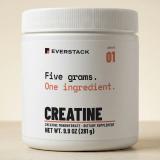
Want the free creatine tub? It comes with Foundation, our 30-day box of creatine, omega-3, magnesium glycinate and the multivitamin: $69 (the four bought separately: $112.60). Code FIRST100 is added for you, first 100 Foundation orders, one per customer.
Buy Foundation, $69Short answer
At 3 to 5 g a day, healthy adults have little to worry about. The real effects are small and predictable: a little water weight in muscle at the start, a higher creatinine number on kidney blood tests (a lab quirk, not kidney damage), and stomach upset when people take big single doses. Trials do not support kidney damage in healthy people, dehydration or cramps, and the hair loss worry rests on one small study that never measured hair. Our creatine guide grades safety at 3 to 5 g a day A; the detailed safety summary gets grade B overall, because the hair and stomach answers each rest on a single trial and randomized data beyond about a year are scarce. Grades rate the research on the molecule, not our product.
BB Good human data, but mixed outcomes or surrogate markers. How we grade → Our grade: Creatine safety: kidneys, hair, water weight and stomach (overall)
1. Kidneys: a blood test number moves, kidney function does not
Creatine breaks down into creatinine, the marker most kidney blood tests use to estimate filtration (eGFR). So creatine can raise creatinine and make eGFR read lower without any change in how your kidneys work. In a 2026 meta-analysis of 20 randomized trials, blood creatinine was about 0.13 mg/dL higher with creatine, while urea and estimated filtration did not change. Trials that measured filtration directly found no drop: in a 12-week trial in lifters eating 1.2 to 3 g of protein per kg a day, measured filtration stayed level. Most of these trials lasted 3 months or less in healthy adults. Before any kidney blood test, tell whoever orders it that you take creatine.
2. Hair loss: one small study, and it never measured hair
The worry comes from a 2009 study of 20 rugby players: after a week of loading at 25 g a day, DHT (a hormone linked to male pattern hair loss) rose 56%. Hair was not measured, values stayed within normal limits and the result was never repeated. The only trial that measured hair, in 45 men taking 5 g a day for 12 weeks, found no change in DHT, hair density, follicle count or thickness compared with placebo. Both studies were small and in young men.
3. Water weight and bloating: real, small, mostly inside muscle
Creatine pulls water into muscle cells, so the scale often goes up at first. The NIH Office of Dietary Supplements notes a 1 to 2 kg rise over a month of strength training, and a loading week of about 20 g a day typically adds 1 to 3 kg, mostly water. Loading is optional: 3 g a day filled muscle as much as 20 g a day, just more slowly. Starting at 5 g a day with no loading phase avoids most of the early jump.
4. Stomach upset: mostly a big single dose problem
In a trial in 59 athletes, diarrhea was reported by 55.6% on one 10 g dose a day, 28.6% on two 5 g doses and 35.0% on placebo, so splitting the dose brought it back to placebo levels. Stomach complaints were common in every group, placebo included, and this is a single trial. A 5 g serving stirred fully into a glass of water, with a meal if your stomach is sensitive, is a low-risk habit, though no trial has tested that tip.
5. Dehydration and cramps: not supported
A systematic review of 10 controlled trials found no sign that creatine hurts heat tolerance or fluid balance at recommended doses. Over 3 football seasons in heat up to 40 C, players taking creatine had no more cramps, heat illness or dehydration than their share of the team; that record was open-label, so players chose whether to take it.
6. Long-term use: reassuring, but mostly not randomized
In 98 college football players followed for up to 21 months, those who took creatine showed no clinically meaningful differences from non-users across a broad blood and urine panel. The NIH Office of Dietary Supplements calls creatine safe for short-term use by healthy adults and cites evidence that several years of use is safe. These long-term records are open-label or observational, which is why randomized trials longer than a year are still needed.
Who should talk to a clinician first
Talk to your clinician before starting if you have kidney disease, reduced kidney function or a single kidney, take medicines that can affect the kidneys or any regular medication, or are pregnant or breastfeeding (there are no human studies in pregnancy). Not for people under 18. Ours is plain creatine monohydrate, 5 g once a day with no loading phase: $27.90 for a 281 g tub, about $0.56 a day.
Questions
Is creatine bad for your kidneys?
In healthy adults, trials have not found kidney harm. Creatine raises blood creatinine, so a kidney blood test can look worse while measured kidney function stays the same. If you have kidney disease, ask your clinician first.
Does creatine cause hair loss?
No trial has shown it. The worry comes from one small study that measured a hormone, not hair, and the only trial that measured hair found no change after 12 weeks at 5 g a day.
Does creatine make you bloated or gain weight?
Expect about 1 to 2 kg on the scale in the first weeks, mostly water held inside muscle, not fat. Skipping the loading phase keeps the early jump smaller.
Why does creatine upset my stomach?
Large single doses are the usual cause: one 10 g dose caused more diarrhea than two 5 g doses in a trial. Take 5 g once a day, fully dissolved, with a meal if needed.
Not ready to buy yet?
A short email when there is something worth saying: the evidence we have graded, label changes, and new batches.
Sources (each DOI or PMID checked on Crossref or PubMed, 25 Oct 2026)
- Kreider RB et al. J Int Soc Sports Nutr. 2017;14:18. ISSN position stand on creatine.
- Antonio J et al. J Int Soc Sports Nutr. 2021;18:13. Common questions and misconceptions about creatine.
- Tsiaras A et al. J Ren Nutr. 2026. Creatine and kidney markers, meta-analysis of 20 randomized trials.
- Lugaresi R et al. J Int Soc Sports Nutr. 2013;10:26. 12 weeks of creatine on a high-protein diet, filtration measured directly.
- Gualano B et al. Eur J Appl Physiol. 2008;103(1):33-40. About 10 g a day for 3 months, cystatin C.
- van der Merwe J, Brooks NE, Myburgh KH. Clin J Sport Med. 2009;19(5):399-404. 3 weeks, 20 rugby players, DHT (hair not measured).
- Lak M et al. J Int Soc Sports Nutr. 2025;22(sup1):2495229. 12-week randomized trial, hair and androgens, 45 men.
- Hultman E et al. J Appl Physiol. 1996;81(1):232-237. Muscle creatine loading, 20 g vs 3 g a day.
- Deminice R et al. Int J Sports Med. 2016;37(2):149-153. Total body water after 7 days of loading.
- Ostojic SM, Ahmetovic Z. Res Sports Med. 2008;16(1):15-22. One 10 g dose vs two 5 g doses, 59 athletes.
- Lopez RM et al. J Athl Train. 2009;44(2):215-223. Creatine, heat tolerance and hydration, systematic review.
- Greenwood M et al. Mol Cell Biochem. 2003;244(1-2):83-88. Cramping and injury over 3 football seasons.
- Kreider RB et al. Mol Cell Biochem. 2003;244(1-2):95-104. Up to 21 months of creatine, 98 football players, health panel.
- NIH Office of Dietary Supplements. Dietary Supplements for Exercise and Athletic Performance, fact sheet for health professionals (creatine section).
Read next
- Full summary: creatine safety, kidneys, hair and water
- Creatine monohydrate benefits, each one graded
- When to take creatine
- Our creatine guide
- All buyer guides
* These statements have not been evaluated by the Food and Drug Administration. This product is not intended to diagnose, treat, cure, or prevent any disease.