Buyer guides · Updated 2026-11-14
Do you need to cycle creatine, and what happens when you stop taking it?
Free US shipping · Sources linked below. Or read the guide first
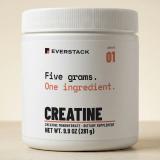
Want the free creatine tub? It comes with Foundation, our 30-day box of creatine, omega-3, magnesium glycinate and the multivitamin: $69 (the four bought separately: $112.60). Code FIRST100 is added for you, first 100 Foundation orders, one per customer.
Buy Foundation, $69Short answer
No study has shown that you need to cycle creatine, and no trial has compared cycling with taking it every day. When you stop, the extra creatine in muscle fades back to your starting level over about 4 weeks in most people (one man was still above baseline after 30 days), and some of the water weight gained at the start would be expected to go with it. The International Society of Sports Nutrition notes that no study has found muscle creatine falling below its starting level after stopping, so the body's own production does not appear to be switched off. In the one small study of stopping, older men kept their strength and lean mass for 12 weeks while they kept training. Our grade for this question is C, because the answers on strength and cycling rest on very few people. The main benefit, strength and lean mass with resistance training while you take it, is graded A. Grades rate the research on the molecule, not our product.
CC Small or few human trials. Promising, not proven. How we grade → Our grade: Stopping creatine and cycling it (overall)
1. How fast muscle creatine falls after you stop
This has been measured with muscle biopsies. In Hultman 1996, 6 days at 20 g a day raised muscle creatine by about 20%; without further creatine the level drifted down and was no different from the starting value 30 days after stopping. In Vandenberghe 1997, 19 young women, muscle phosphocreatine returned to normal within 4 weeks of stopping. The exception is a case study of one man (Rawson 2004): after 30 days off, his phosphocreatine had fallen only 22% from its peak and his body weight stayed 2.0 kg higher. Limits: these studies are small, and most people loaded at 20 g a day first; the timeline after steady use of 3 to 5 g a day has not been measured directly, though it is reasonable to expect it to be similar.
2. Strength and muscle after stopping: training matters most
While women in Vandenberghe 1997 stayed on 5 g a day, strength of the trained muscles rose 20% to 25% more than with placebo and fat-free mass 60% more, and both stayed higher than placebo through 10 weeks without training. After stopping, the only study we found is Candow 2004: 8 older men (mean age 73) who stopped creatine and 5 who never took it all trained for 12 weeks at a third lower volume. Strength and lean mass did not change in either group, and muscle endurance fell 7% to 21% at a similar rate in both. Limits: 13 men, not randomized to stop, and training was reduced rather than stopped.
3. Does creatine shut down your own production?
This is the usual reason given for cycling. The ISSN position stand (Kreider 2017) states that no evidence suggests muscle creatine falls below baseline after supplements stop, so long-term suppression of the body's own creatine production does not appear to occur. That is a reading of muscle data, not a direct measure of creatine synthesis. On long-term use, players who took creatine for up to 21 months showed no differences from non-users on a 54-item blood and urine panel (Kreider 2003, open-label, athletes chose whether to take it).
4. Cycling vs taking it every day: never tested
No trial has compared cycling with continuous use on any outcome. What we take from the evidence: there is no evidence that cycling is needed, and no evidence that a break hurts either. A break simply means muscle levels drift back toward baseline over about a month, so any benefit that depends on full stores would be expected to fade with them; that is an inference, not a measured result.
5. Restarting: no loading phase needed
In Hultman 1996, 3 g a day without loading raised muscle creatine by a similar 20% over 28 days, and in the one-man case study a second loading reached a similar peak to the first. So after a break you can go straight back to a daily dose; loading only gets you there sooner. Ours is 5 g once a day with no loading phase: one scoop, 50 servings in the tub, $27.90, about $0.56 a day. Ask a clinician before starting or restarting if you have kidney disease or reduced kidney function, are pregnant or breastfeeding, or have a medical condition or take regular medication. For adults 18 and older.
Questions
Should I cycle creatine on and off?
There is no evidence that you need to. No trial has compared cycling with daily use, and no study has found muscle creatine falling below its starting level after people stop.
What happens when you stop taking creatine?
Muscle creatine drifts back to your starting level over about 4 weeks in most people, and some early water weight would be expected to go with it. In the one small study of stopping, strength and lean mass held for 12 weeks while training continued.
Will I lose muscle if I stop creatine?
Not in the one study that checked: older men who stopped creatine and kept training at a lower volume kept their lean mass for 12 weeks, like men who never took it. The scale may drop a little as water held in muscle goes.
Do I need to load again after a break?
No. A steady 3 g a day refilled muscle creatine in about 4 weeks in one study; our serving is 5 g a day. Loading only gets you there faster.
Not ready to buy yet?
A short email when there is something worth saying: the evidence we have graded, label changes, and new batches.
Sources (each DOI or PMID checked on Crossref or PubMed, 25 Oct 2026)
- Hultman E et al. J Appl Physiol. 1996;81(1):232-237. Muscle creatine loading, 20 g vs 3 g a day.
- Vandenberghe K et al. J Appl Physiol. 1997;83(6):2055-2063. Long-term creatine with resistance training, then detraining and stopping, 19 women.
- Rawson ES et al. J Strength Cond Res. 2004;18(1):162-167. Case study: two loadings with a 30-day washout.
- Candow DG et al. J Aging Phys Act. 2004;12(3):219-231. Stopping creatine while training continued in older men.
- Kreider RB et al. Mol Cell Biochem. 2003;244(1-2):95-104. Up to 21 months of creatine, 98 football players, health panel.
- Kreider RB et al. J Int Soc Sports Nutr. 2017;14:18. ISSN position stand on creatine.
Read next
- Full summary: stopping creatine and cycling it
- How much creatine per day
- Creatine and water weight
- Creatine side effects, checked against the trials
- All buyer guides
* These statements have not been evaluated by the Food and Drug Administration. This product is not intended to diagnose, treat, cure, or prevent any disease.