Buyer guides · Updated 2026-11-04
Omega-3 fish oil benefits: which ones the trials support, and which they do not
Free US shipping · Sources linked below. Or read the guide first
Short answer
The benefit with the strongest evidence is the simplest one: fish oil raises the EPA and DHA in your red blood cells (the Omega-3 Index), grade A, and the rise depends on the dose. Two more uses have good trials but at much higher doses than a supplement serving: lower triglycerides at about 4 g a day (grade B) and a small drop in resting blood pressure at 2 to 3 g a day (grade B). Muscle (grade C) and aging clocks (grade C) are early, and living longer is not shown (grade D). At about 1 g a day, the large trials in people without heart disease were flat on their main heart outcomes. Our overall omega-3 grade is B. Below is each benefit people mention, with its own grade. Grades rate the research on the molecule, not our product.
BB Good human data, but mixed outcomes or surrogate markers. How we grade → Our grade: Omega-3 (EPA and DHA): overall evidence
AA Multiple randomized trials or meta-analyses, consistent results. How we grade → 1. EPA and DHA levels in your blood
This is what fish oil does most reliably. Supplements raise EPA and DHA in red blood cells, measured as the Omega-3 Index, and more omega-3 gives a bigger rise. In 115 healthy adults, dose alone explained about 68% of the change over about 5 months. A pool of 14 trials (1,422 people) found the index rose from 4.9% to 8.1% at a mean of about 2 g a day, and a model from that pool predicted that 850 mg a day as ethyl esters would take a starting index of 4.9% to about 6.5%. Our 2 softgels give 600 mg, below the doses in those trials, so expect a smaller rise. Eating oily fish about twice a week does much of the same job.
BB Good human data, but mixed outcomes or surrogate markers. How we grade → 2. Triglycerides: strong, at about 4 g a day
The most consistent finding in the trials: at prescription doses of about 4 g a day, EPA and DHA lower very high triglycerides by 30% or more (American Heart Association advisory). A 600 mg serving is far below that dose, and very high triglycerides are a medical matter for a clinician, not a reason to buy a supplement. Our claim is structure/function only: EPA and DHA support healthy triglyceride levels already within the normal range.
BB Good human data, but mixed outcomes or surrogate markers. How we grade → 3. Resting blood pressure: small, at 2 to 3 g a day
A dose-response meta-analysis of 4,973 people found systolic pressure 2.61 mm Hg lower at 2 g and at 3 g a day of EPA plus DHA, with a stronger relation in people with hypertension. A Cochrane review of trials lasting at least 12 months found little or no effect, and in 2,157 adults 70 and older, 1 g a day for 3 years left systolic pressure 0.8 mm Hg lower, a difference that was not statistically significant. That is research on the molecule at doses several times ours; it is not a claim we make for our product.
CC Small or few human trials. Promising, not proven. How we grade → 4. Muscle strength and lean mass: promising, not proven
Reviews in healthy adults do not show a clear gain in muscle mass. A review of 14 trials (1,443 people) found only a very small strength effect and rated the trials at high risk of bias, while a review in adults 55 and older reported better lower-body strength but no more lean mass. A 6-month trial that 44 people finished found a 3.6% rise in thigh muscle volume. For strength, resistance training, and creatine with it, have far stronger evidence.
CC Small or few human trials. Promising, not proven. How we grade → 5. DNA methylation aging clocks: early
One post hoc analysis of 777 adults aged 70 and older found that 1 g a day of omega-3 for 3 years slowed three DNA methylation clocks by 2.9 to 3.8 months. The authors called this a small effect on surrogate clocks. The same trial's main results, in 2,157 adults, found no statistically significant difference in physical performance, a cognition score, fractures, infections or blood pressure. A clock reading is a lab measure, not proof of a longer life. We make no aging claim for our product.
DD Mostly mechanistic or early data. Shown openly. How we grade → 6. Living longer: not shown
Cohorts link a higher Omega-3 Index with lower death rates (in the Framingham Offspring cohort, 34% lower in the top fifth), but cohorts cannot show cause. In the VITAL trial, 1 g a day did not change death from any cause, and no trial has tested whether raising the index lengthens life. We do not claim that fish oil helps you live longer.
7. Heart attacks and strokes: not a claim we make
This is disease research, so we give no product grade here. At about 1 g a day, the two largest trials in people without heart disease were flat on their main outcomes: in VITAL, major cardiovascular events occurred in 386 versus 419 people (hazard ratio 0.92, 95% CI 0.80 to 1.06), and in ASCEND, in adults with diabetes, serious vascular events occurred in 8.9% versus 9.2%. A meta-analysis of 10 trials in 77,917 people found no significant effect on coronary death or major vascular events. A supplement is not a way to prevent or treat heart disease; if you have heart disease, talk with your clinician.
How to take it, and who should check first
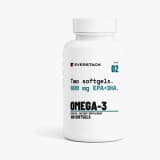
Read the label for milligrams of EPA plus DHA, not fish oil: a common 1,000 mg softgel gives about 180 mg of EPA and 120 mg of DHA. Ours is 1 softgel twice a day with meals, 360 mg of EPA and 240 mg of DHA (600 mg combined) from 2,000 mg of fish oil concentrate; omega-3s are absorbed best with a meal that contains some fat. More is not better: across 7 trials, atrial fibrillation was about 25% more likely with omega-3 overall (hazard ratio 1.25), more so above 1 g a day (1.49) than at 1 g or less (1.12). It contains fish (sardines, anchovies), so skip it if you are allergic to fish. Ask a clinician first if you take a blood thinner such as warfarin, have atrial fibrillation or another heart rhythm problem, or are pregnant or breastfeeding. For adults 18 and older. Ours is $24.90 for 50 days, about $0.50 a day.
Questions
What are the benefits of omega-3 fish oil?
It reliably raises EPA and DHA in your blood (grade A). Lower triglycerides (grade B) and a small drop in resting blood pressure (grade B) were found at 2 to 4 g a day, well above a supplement serving. Muscle and aging clocks are early, and living longer is not shown.
Does fish oil help your heart?
At about 1 g a day, the largest trials in people without heart disease did not lower major heart events. We make no heart claim for our product. If you have heart disease or high triglycerides, talk with your clinician.
How long does fish oil take to work?
Red blood cells turn over slowly, so the Omega-3 Index rises over months; the dose trials measured the change over about 5 months. An Omega-3 Index test shows where you start.
Can I just eat fish instead?
Yes. Oily fish about twice a week does much of the same job. A supplement is for people who rarely eat fish.
Not ready to buy yet?
A short email when there is something worth saying: the evidence we have graded, label changes, and new batches.
Sources (each DOI or PMID checked on Crossref or PubMed, 25 Oct 2026)
- Flock MR et al. J Am Heart Assoc. 2013;2(6):e000513. Fish oil dose and red blood cell omega-3, 115 healthy adults, about 5 months.
- Walker RE et al. Am J Clin Nutr. 2019;110(4):1034-1040. Predicting the Omega-3 Index from EPA and DHA dose, 14 trials, 1,422 people.
- Skulas-Ray AC et al. Circulation. 2019;140(12):e673-e691. Omega-3s for high triglycerides, American Heart Association science advisory.
- Zhang X et al. J Am Heart Assoc. 2022;11(11):e025071. Omega-3 intake and blood pressure, dose-response meta-analysis of randomized trials.
- Abdelhamid AS et al. Cochrane Database Syst Rev. 2020;3:CD003177. Omega-3 fatty acids and cardiovascular disease.
- Bischoff-Ferrari HA et al. JAMA. 2020;324(18):1855-1868. DO-HEALTH, vitamin D, omega-3 and exercise in 2,157 adults 70 and older.
- Santo André HC et al. Adv Nutr. 2023;14(1):115-127. Omega-3 and muscle strength, mass and function, meta-analysis.
- Cornish SM et al. Nutrients. 2022;14(11):2221. Omega-3 with or without resistance exercise in older adults, review.
- Smith GI et al. Am J Clin Nutr. 2015;102(1):115-122. Fish oil and muscle mass and function in healthy older adults, 6 months.
- Bischoff-Ferrari HA et al. Nat Aging. 2025;5(3):376-385. DO-HEALTH post hoc analysis, DNA methylation clocks, 777 adults.
- Harris WS et al. J Clin Lipidol. 2018;12(3):718-727. Omega-3 Index and mortality in the Framingham Offspring cohort.
- Manson JE et al. N Engl J Med. 2019;380(1):23-32. VITAL, 1 g omega-3 a day.
- ASCEND Study Collaborative Group (Bowman L et al.). N Engl J Med. 2018;379(16):1540-1550. Omega-3 in adults with diabetes.
- Aung T et al. JAMA Cardiol. 2018;3(3):225-234. Omega-3 supplements and cardiovascular events, meta-analysis of 10 trials, 77,917 people.
- Gencer B et al. Circulation. 2021;144(25):1981-1990. Omega-3 dose and atrial fibrillation, 7 trials.
- Lawson LD, Hughes BG. Biochem Biophys Res Commun. 1988;156(2):960-963. Fish oil absorption with a high-fat meal. PMID 2847723.
- NIH Office of Dietary Supplements. Omega-3 Fatty Acids fact sheet for health professionals.
Read next
- Every claim we grade, with sources
- Omega-3 dose: how much EPA and DHA you need
- Full summary: omega-3 dose and form
- The Omega-3 Index
- All buyer guides
* These statements have not been evaluated by the Food and Drug Administration. This product is not intended to diagnose, treat, cure, or prevent any disease.