Buyer guides · Updated 2026-11-06
Vitamin D benefits: which ones the trials support, and which they do not
Free US shipping · Sources linked below. Or read the guide first
Short answer
The benefit with the strongest evidence is the simplest one: a vitamin D supplement raises 25-hydroxyvitamin D in blood, grade A. Across 49 European trials in 7,320 adults, the mean rise versus placebo was about 36 nmol/L, and a review of 136 trials found a clear dose response. Muscle strength is mixed (grade B): one meta-analysis found a small gain, a later one found none. Bone health when your level is low (grade D) and normal immune function when your level is low (grade D) are both grade D for insufficient human evidence of a supplement benefit. Living longer is not shown (grade D). Megadoses for everyone are not supported: the adult upper limit is 4,000 IU a day, and in one 3-year trial 4,000 and 10,000 IU a day lost more forearm bone density than 400 IU. Our overall vitamin D grade for the uses on our multivitamin label is D. Below is each benefit people mention, with its own grade. Grades rate the research on the molecule, not our product.
DD Mostly mechanistic or early data. Shown openly. How we grade → Our grade: Vitamin D3 (in the multivitamin): overall evidence
AA Multiple randomized trials or meta-analyses, consistent results. How we grade → 1. Raising a low vitamin D level
This is what vitamin D does most reliably. Randomized trials consistently show that a supplement raises 25-hydroxyvitamin D in blood. Across 49 European trials (7,320 adults), the mean rise versus placebo was about 36 nmol/L, and a global review of 136 trials found a clear dose response. These trials tested vitamin D itself, often at doses above the 400 IU in a typical daily multivitamin, and a higher blood level is a status result, not a disease result. A blood test is the best way to know where you start.
BB Good human data, but mixed outcomes or surrogate markers. How we grade → 2. Muscle strength: mixed, no consistent gain
Results conflict, and they do not show a consistent gain. A 2014 meta-analysis of 30 trials (5,615 people) found a small gain in overall muscle strength (standardized mean difference 0.17), more marked when the starting 25-hydroxyvitamin D level was under 30 nmol/L, and no clear change in muscle mass or power. A later meta-analysis of 54 placebo-controlled trials (8,747 people) found no benefit, including in studies with low vitamin D levels, and two measures were slightly worse. In athletes, 13 trials raised the blood level, but physical performance did not improve over 12 weeks. For strength, resistance training, and creatine with it, have far stronger evidence.
DD Mostly mechanistic or early data. Shown openly. How we grade → 3. Bone health when your level is low: insufficient
Vitamin D is needed for bone, and severe deficiency can cause rickets and osteomalacia, which are diseases we do not grade. Pooled trials of vitamin D alone found no effect on fractures or falls and no clinically relevant change in bone density (Bolland 2018, 81 trials). In people starting at or below 30 nmol/L, exploratory or secondary analyses of two randomized trials found bone density benefits at the spine and hip (about 2% at the spine and femoral neck in Reid 2017, in a subgroup of 46 people; Macdonald 2018, postmenopausal women on 400 or 1,000 IU a day), but we found no trial of vitamin D alone showing fewer fractures in people who start low. So the evidence for this use is insufficient, which is not the same as evidence against it. Vitamin D with calcium cut hip fractures in very old women in care homes, but that tested a combination (Chapuy 1992). We make no bone claim for our product beyond what the label allows as structure/function language.
DD Mostly mechanistic or early data. Shown openly. How we grade → 4. Normal immune function when your level is low: insufficient
In the 2025 update of the infection trials, vitamin D did not significantly reduce acute respiratory infections in people starting below 25 nmol/L (odds ratio 0.98, 95% CI 0.80 to 1.20; 22 trials, 3,806 people), and the review found no evidence that the effect differed by starting level, age, dose or dosing frequency. The earlier 2017 finding of protection in people starting low was not confirmed. The confidence interval is compatible with a meaningful benefit or harm, so this is not proof of zero effect. Vitamin D is involved in immune function, but these trials measured respiratory infections, not normal immune function as a whole. They do not establish a benefit in people starting low, and they are not evidence against the label claim either: for this use, the human evidence is insufficient. This grade is about what a supplement was shown to add.
DD Mostly mechanistic or early data. Shown openly. How we grade → 5. Living longer: not shown
In the D-Health trial, monthly vitamin D for 5 years in 21,315 adults aged 60 and older did not lower deaths from any cause (hazard ratio 1.04, 95% CI 0.93 to 1.18). In VITAL, 2,000 IU a day for a median of 5.3 years in 25,871 adults also did not (hazard ratio 0.99, 95% CI 0.87 to 1.12). Neither trial selected people for a low starting level. We do not claim that vitamin D helps you live longer.
6. Cancer and heart disease: not a claim we make
This is disease research, so we give no product grade here. In the VITAL trial, 2,000 IU a day for a median of 5.3 years in 25,871 adults did not lower rates of invasive cancer or major heart events. A supplement is not a way to prevent or treat cancer or heart disease; if you have either, talk with your clinician.
7. Megadoses for everyone: not supported
The US adult upper limit is 4,000 IU a day from food and supplements combined (NIH ODS; IOM 2011). In a 3-year randomized trial in 311 healthy adults, 10,000 IU a day lost more forearm bone density (about 3.5%) than 400 IU (about 1.2%), and 4,000 IU a day also lowered radial bone density versus 400 IU. Raising a low level is well supported; taking 10,000 IU a day because you saw it online is not. Test if you rarely get sun, then dose to the result with a clinician if needed.
How to take it, and who should check first
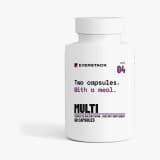
Take it with a meal that contains some fat: vitamin D is fat-soluble, and fat in the gut helps absorption (NIH ODS). Our multivitamin gives 400 IU (10 mcg) of vitamin D3 per 2 capsules in the morning. Count every vitamin D supplement and fortified food you take so you stay under the 4,000 IU adult upper limit. Ask a clinician first if you have high blood calcium, kidney stones, kidney disease, granulomatous disease such as sarcoidosis, or are pregnant or breastfeeding. For adults 18 and older. Ours is $32.90 for 30 days, about $1.10 a day.
Questions
What are the benefits of vitamin D?
It reliably raises a low blood 25-hydroxyvitamin D level (grade A). Muscle strength is mixed (grade B). Bone and immune uses when your level is low are grade D and D for insufficient evidence of a supplement benefit. Living longer is not shown (grade D).
Does vitamin D help you live longer?
No. In D-Health (21,315 adults 60+) and VITAL (25,871 adults), vitamin D did not lower deaths from any cause. Our grade is D.
Is 10,000 IU of vitamin D a day safe?
The adult upper limit is 4,000 IU a day. In a 3-year trial in 311 healthy adults, 10,000 IU a day lost more forearm bone density than 400 IU. Raising a low level is well supported; megadoses for everyone are not.
How much vitamin D is in your multivitamin?
400 IU (10 mcg) of vitamin D3 per 2 capsules. That is a modest add to food and sun, not a megadose.
Not ready to buy yet?
A short email when there is something worth saying: the evidence we have graded, label changes, and new batches.
Sources (each DOI or PMID checked on Crossref or PubMed, 25 Oct 2026)
- Rupprecht M et al. Nutrients. 2023;15(18):3986. Vitamin D trials in healthy European adults, 49 trials, 7,320 adults.
- Mo M et al. Eur J Clin Nutr. 2019;73(6):816-834. Serum 25-hydroxyvitamin D response, systematic review of 136 trials.
- Beaudart C et al. J Clin Endocrinol Metab. 2014;99(11):4336-4345. Vitamin D and muscle strength, meta-analysis of 30 trials.
- Bislev LS et al. J Bone Miner Res. 2021;36(9):1651-1660. Vitamin D and muscle health, meta-analysis of 54 placebo-controlled trials.
- Farrokhyar F et al. Sports Med. 2017;47(11):2323-2339. Vitamin D in athletes, 13 trials.
- Bolland MJ et al. Lancet Diabetes Endocrinol. 2018;6(11):847-858. Vitamin D, fractures, falls and bone density, 81 trials.
- Ross AC et al. J Clin Endocrinol Metab. 2011;96(1):53-58. IOM Dietary Reference Intakes for calcium and vitamin D.
- Reid IR et al. J Intern Med. 2017;282(5):452-460. Monthly vitamin D and bone density by starting level, exploratory.
- Macdonald HM et al. J Bone Miner Res. 2018;33(8):1464-1469. Vitamin D supplements and bone density, secondary analysis.
- Burt LA et al. JAMA. 2019;322(8):736-745. 400 vs 4,000 vs 10,000 IU a day for 3 years, 311 adults.
- Chapuy MC et al. N Engl J Med. 1992;327(23):1637-1642. Vitamin D3 with calcium in older women in care homes.
- Jolliffe DA et al. Lancet Diabetes Endocrinol. 2025;13(4):307-320. Vitamin D and acute respiratory infections, updated individual-participant meta-analysis.
- Martineau AR et al. BMJ. 2017;356:i6583. Vitamin D and acute respiratory tract infections.
- Jolliffe DA et al. BMJ. 2022;378:e071230. CORONAVIT, test-and-treat vitamin D and COVID-19.
- Neale RE et al. Lancet Diabetes Endocrinol. 2022;10(2):120-128. D-Health trial, monthly vitamin D and mortality, 21,315 adults 60+.
- Manson JE et al. N Engl J Med. 2019;380(1):33-44. VITAL vitamin D arm, cancer and cardiovascular disease, 25,871 adults.
- NIH Office of Dietary Supplements. Vitamin D fact sheet for health professionals.
Read next
- Every claim we grade, with sources
- Full summary: vitamin D testing and dose
- We graded the hype: 10,000 IU of vitamin D a day
- Multivitamin benefits, each one graded
- All buyer guides
* These statements have not been evaluated by the Food and Drug Administration. This product is not intended to diagnose, treat, cure, or prevent any disease.