Buyer guides · Updated 2026-11-10
Creatine for running and sprinting: repeated sprints, distance, water weight and dose, checked against the trials
Free US shipping · Sources linked below. Or read the guide first
Want the free creatine tub? It comes with Foundation, our 30-day box of creatine, omega-3, magnesium glycinate and the multivitamin: $69 (the four bought separately: $112.60). Code FIRST100 is added for you, first 100 Foundation orders, one per customer.
Buy Foundation, $69Short answer
It depends on the kind of running. For repeated short sprints, as in team sports or interval sessions, we grade the evidence B: a 2022 meta-analysis of 14 trials found higher mean power during repeated sprints after 3 to 7 days at about 20 g a day, with no clear change in peak power or fatigue. For distance running the answer is no benefit shown: an earlier meta-analysis found small benefits for very short efforts and no benefit for running or swimming. Creatine also adds a little water weight, which a distance runner carries every step. If you lift as part of your training, strength and lean mass with resistance training is grade A. Grades rate the research on the molecule, not our product.
BB Good human data, but mixed outcomes or surrogate markers. How we grade → Our grade: Creatine monohydrate: mean power during repeated short sprints
BB Good human data, but mixed outcomes or surrogate markers. How we grade → 1. Repeated short sprints: a real but narrow result
A 2022 meta-analysis of 14 trials found higher mean power during repeated sprints after 3 to 7 days at about 20 g a day (standardized mean difference 0.61). Peak power and fatigue did not clearly change. Mean power across a set of sprints is what matters in sports with repeated bursts, such as soccer, basketball or interval sessions on the track, so this is the use with the most support for runners. The result is uneven outside repeated sprint tests, which is why the grade is B and not A.
2. Distance running: no benefit shown
An earlier meta-analysis of creatine and performance found small benefits for very short efforts and no benefit for running or swimming. We have no grade that supports creatine for distance running, and we make no endurance claim for our product. If your goal is a faster 10 km or marathon, creatine is not where the evidence points.
3. Water weight: a real cost for runners
Creatine pulls water into muscle cells, so body weight often goes up at first. The NIH Office of Dietary Supplements notes a 1 to 2 kg rise over a month of strength training, and a loading week of about 20 g a day typically adds 1 to 3 kg, mostly water. For a sprinter that may not matter; for a distance runner it is extra weight carried every step. Skipping the loading phase keeps the early jump smaller.
AA Multiple randomized trials or meta-analyses, consistent results. How we grade → 4. Strength work in the gym: the best supported use
Many runners lift once or twice a week. Strength and lean mass with resistance training is the use on our label and the one with the most trials: in a pooled analysis of 22 randomized trials in 721 older adults who trained, creatine added about 1.4 kg more lean mass and more strength than the same training with a placebo. Those trials were in lifters, not runners, so they say nothing about race times.
5. Heat, hydration and cramps: not supported as worries
A systematic review of 10 controlled trials found no sign that creatine hurts heat tolerance or fluid balance at recommended doses. Over 3 football seasons in heat up to 40 C, players taking creatine had no more cramps, heat illness or dehydration than their share of the team; that record was open-label, so players chose whether to take it.
6. Dose, loading and your stomach
The sprint trials loaded at about 20 g a day for 3 to 7 days. Loading is optional: in a classic study, 20 g a day for 6 days and 3 g a day for 28 days ended at about the same muscle creatine level, so 3 to 5 g a day gets there in about 4 weeks with less water weight. If you do load, split the 20 g into four doses of 5 g: in a trial in 59 athletes, diarrhea was reported by 55.6% on one 10 g dose a day, 28.6% on two 5 g doses and 35.0% on placebo. Avoid trying a loading week for the first time right before a race.
Who should check first, and drug testing
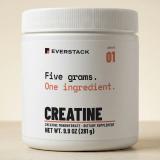
Talk to a clinician first if you have kidney disease, are pregnant or breastfeeding, or take medicines that affect the kidneys. In a 2026 meta-analysis of 20 randomized trials, blood creatinine was about 0.13 mg/dL higher with creatine while estimated filtration did not change, so tell whoever orders your blood tests that you take it. If you are drug tested in sport, choose a product with a third-party certification: we have not published independent lab results for our tub. For adults 18 and older. Ours is plain creatine monohydrate, $27.90 for a 281 g tub, about $0.56 a day at 5 g.
Questions
Does creatine help with running?
For repeated short sprints, pooled trials found higher mean power (grade B). For distance running, a meta-analysis found no benefit, and we make no endurance claim.
Should distance runners take creatine?
There is no trial support for faster distance times, and the early water weight is a cost. It may still make sense if you lift regularly, since strength with resistance training is its best supported use.
Will creatine make me heavier or slower?
Expect about 1 to 2 kg on the scale over the first weeks, mostly water inside muscle. Whether that slows you depends on your event; skipping the loading phase keeps the early jump smaller.
Do I need to load creatine before a race?
No. Loading fills muscle stores in about a week; 3 to 5 g a day gets to the same level in about 4 weeks. If you load, split it into four 5 g doses and test it in training first.
Not ready to buy yet?
A short email when there is something worth saying: the evidence we have graded, label changes, and new batches.
Sources (each DOI or PMID checked on Crossref or PubMed, 25 Oct 2026)
- Glaister M, Rhodes L. Int J Sport Nutr Exerc Metab. 2022;32(6):491-500. Short-term creatine and repeated sprint ability, meta-analysis.
- Branch JD. Int J Sport Nutr Exerc Metab. 2003;13(2):198-226. Creatine, body composition and performance, meta-analysis.
- Chilibeck PD et al. Open Access J Sports Med. 2017;8:213-226. Creatine with resistance training in older adults, 22 trials. PMID 29138605.
- NIH Office of Dietary Supplements. Dietary Supplements for Exercise and Athletic Performance, fact sheet for health professionals (creatine section).
- Deminice R et al. Int J Sports Med. 2016;37(2):149-153. Total body water after 7 days of loading.
- Hultman E et al. J Appl Physiol. 1996;81(1):232-237. Muscle creatine loading, 20 g vs 3 g a day.
- Ostojic SM, Ahmetovic Z. Res Sports Med. 2008;16(1):15-22. One 10 g dose vs two 5 g doses, 59 athletes.
- Lopez RM et al. J Athl Train. 2009;44(2):215-223. Creatine, heat tolerance and hydration, systematic review.
- Greenwood M et al. Mol Cell Biochem. 2003;244(1-2):83-88. Cramping and injury over 3 football seasons.
- Tsiaras A et al. J Ren Nutr. 2026. Creatine and kidney markers, meta-analysis of 20 randomized trials.
- Kreider RB et al. J Int Soc Sports Nutr. 2017;14:18. ISSN position stand on creatine.
Read next
- Creatine monohydrate benefits, each one graded
- When to take creatine
- Creatine side effects, checked against the trials
- Every claim we grade, with sources
- All buyer guides
* These statements have not been evaluated by the Food and Drug Administration. This product is not intended to diagnose, treat, cure, or prevent any disease.