Buyer guides · Updated 2026-11-11
Omega-3 fish oil side effects: what to expect, and what to watch for
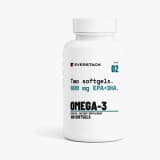
Free US shipping · Sources linked below. Or read the guide first
Short answer
At label doses, the side effects people actually get from fish oil are mild and digestive: an unpleasant or fishy taste, bad breath, heartburn, nausea, stomach discomfort or diarrhea, sometimes headache or smelly sweat (NIH Office of Dietary Supplements). The one signal worth knowing about is heart rhythm: across 7 large trials, omega-3 supplements were linked to more atrial fibrillation, mostly at doses above 1 g a day. Bleeding is the other common worry; fish oil can have antiplatelet effects at high doses, so anyone on a blood thinner should ask a clinician first. FDA and Europe's food safety regulator consider up to about 5 g a day of EPA plus DHA safe for adults. Our safety summary grades the omega-3 dose and form evidence B overall. Below is each worry people have before buying, with its sources. Grades rate the research on the molecule, not our product.
BB Good human data, but mixed outcomes or surrogate markers. How we grade → Our grade: Omega-3 dose and form, including safety (overall)
1. Fishy taste, burps, heartburn and loose stools: the usual ones
NIH's Office of Dietary Supplements lists the commonly reported side effects of omega-3 supplements as usually mild: unpleasant taste, bad breath, heartburn, nausea, gastrointestinal discomfort, diarrhea, headache and odoriferous sweat. A fishy aftertaste or burps fall in the same group. Ours is taken as 1 softgel twice a day with meals, mainly because omega-3s are absorbed best with a meal that contains some fat; splitting the dose across two meals also means less oil at once. If a side effect does not settle, stop and ask a clinician.
2. Heart rhythm: the atrial fibrillation signal above 1 g a day
This is the safety finding with the most data behind it. A meta-analysis of 7 cardiovascular outcome trials with 81,210 patients found atrial fibrillation about 25% more likely with omega-3 overall (hazard ratio 1.25), more so in trials above 1 g a day (1.49) than at 1 g or less (1.12). NIH notes that two large trials of 4 g a day for several years slightly increased atrial fibrillation in people with heart disease or at high risk of it. Two of our softgels give 600 mg of EPA plus DHA, below 1 g. If you have atrial fibrillation, palpitations or another heart rhythm problem, ask a clinician before taking any fish oil.
3. Bleeding and blood thinners
Fish oil can have antiplatelet effects at high doses, though it appears less potent than aspirin. The Institute of Medicine noted that 2 to 15 g a day of EPA and DHA might lengthen bleeding time. With warfarin, fish oil might raise clotting test results (INR), although most research indicates that 3 to 6 g a day of fish oil does not significantly change anticoagulant status, and a 2014 review concluded omega-3s do not affect the risk of clinically significant bleeding. Prescription omega-3 labels still advise periodic INR checks with anticoagulants. If you take warfarin or a similar blood thinner, ask your clinician or pharmacist first.
4. How much is too much: the 5 g figure
There is no official US upper limit for omega-3s. FDA has concluded that supplements giving no more than 5 g a day of EPA plus DHA are safe when used as recommended, and the European Food Safety Authority found that long-term intakes up to about 5 g a day appear safe. FDA also says supplement labels should not recommend more than 2 g a day of EPA plus DHA. Read the label for milligrams of EPA plus DHA, not fish oil: a common 1,000 mg softgel gives about 180 mg of EPA and 120 mg of DHA. Ours gives 600 mg combined per 2 softgels. Count every fish oil, cod liver oil and omega-3 product you take.
5. Mercury and fish allergy
Fish can contain methylmercury, but NIH notes that omega-3 supplements have not been found to contain it, because it is removed during processing and purification. That is a statement about fish oil supplements in general; we have not published independent lab results for our bottle. Allergy is the clearer issue: ours contains fish (sardines, anchovies), so do not take it if you are allergic to fish, and ask your allergist first if you have a shellfish allergy.
AA Multiple randomized trials or meta-analyses, consistent results. How we grade → 6. What you get in return
Side effects only make sense next to the benefit. What fish oil does most reliably is raise EPA and DHA in your red blood cells, the Omega-3 Index, and more omega-3 gives a bigger rise: in 115 healthy adults, dose alone explained about 68% of the change over about 5 months. Lower triglycerides (grade B on our claims page) were found at about 4 g a day, far above a supplement serving. Eating oily fish about twice a week does much of the same job without a capsule.
How to take it, and who should check first
Take 1 softgel twice a day with meals: 360 mg of EPA and 240 mg of DHA (600 mg combined) from 2,000 mg of fish oil concentrate. Ask a clinician first if you take a blood thinner such as warfarin, have atrial fibrillation or another heart rhythm problem, or are pregnant or breastfeeding. Do not take it if you are allergic to fish. For adults 18 and older. Ours is $24.90 for 50 days, about $0.50 a day.
Questions
What are the side effects of fish oil?
Usually mild: unpleasant taste, bad breath, heartburn, nausea, stomach discomfort, diarrhea, headache and smelly sweat (NIH ODS). At doses above 1 g a day, pooled trials also found more atrial fibrillation.
Does fish oil cause atrial fibrillation?
Across 7 large trials, omega-3 was linked to more atrial fibrillation (hazard ratio 1.25), mostly above 1 g a day (1.49) versus 1 g or less (1.12). If you have a heart rhythm problem, ask a clinician first.
Can I take fish oil with a blood thinner?
Ask your clinician or pharmacist first. Fish oil can have antiplatelet effects at high doses and might raise INR with warfarin, and prescription omega-3 labels advise periodic INR checks with anticoagulants.
How much fish oil is too much?
FDA and the European Food Safety Authority consider up to about 5 g a day of EPA plus DHA safe for adults. Count milligrams of EPA plus DHA, not fish oil, across everything you take.
Not ready to buy yet?
A short email when there is something worth saying: the evidence we have graded, label changes, and new batches.
Sources (each DOI or PMID checked on Crossref or PubMed, 25 Oct 2026)
- NIH Office of Dietary Supplements. Omega-3 Fatty Acids fact sheet for health professionals.
- Gencer B et al. Circulation. 2021;144(25):1981-1990. Omega-3 dose and atrial fibrillation, 7 trials.
- Lawson LD, Hughes BG. Biochem Biophys Res Commun. 1988;156(2):960-963. Fish oil absorption with a high-fat meal. PMID 2847723.
- Flock MR et al. J Am Heart Assoc. 2013;2(6):e000513. Fish oil dose and red blood cell omega-3, 115 healthy adults, about 5 months.
- Walker RE et al. Am J Clin Nutr. 2019;110(4):1034-1040. Predicting the Omega-3 Index from EPA and DHA dose, 14 trials, 1,422 people.
- Skulas-Ray AC et al. Circulation. 2019;140(12):e673-e691. Omega-3s for high triglycerides, American Heart Association science advisory.
Read next
- Full summary: omega-3 dose and form, with safety
- Omega-3 fish oil benefits, each one graded
- Omega-3 dose: how much EPA and DHA you need
- Every claim we grade, with sources
- All buyer guides
* These statements have not been evaluated by the Food and Drug Administration. This product is not intended to diagnose, treat, cure, or prevent any disease.