Buyer guides · Updated 2026-11-28
When should you take a multivitamin? With a meal that has some fat; the time of day has not been tested
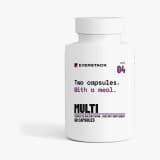
Free US shipping · Sources linked below. Or read the guide first
Short answer
With a meal that has some fat, at whatever time you will remember. Vitamins A (as beta-carotene), D and E dissolve in fat, and in small studies a meal with some fat raised how much of them the body absorbed: a vitamin D3 pill gave a 32% higher peak in the blood with a fat-containing meal than with a fat-free one (Dawson-Hughes 2015), and the share of vitamin E absorbed rose from about 10% with a fat-free breakfast to 33% with a breakfast that had some fat (Bruno 2006). A modest amount of fat seems enough: about 3 g worked as well as 36 g for vitamin E and beta-carotene (Roodenburg 2000). We found no trial comparing morning with evening for a multivitamin. A few medicines, such as levothyroxine and some antibiotics, need to be taken at a different time. These studies measured blood levels, not health, and none tested our capsules.
CC Small or few human trials. Promising, not proven. How we grade → Our grade: Multivitamin timing and absorption (overall)
1. With food: the vitamin D studies
In a randomized single-day study in 50 healthy older adults, one 50,000 IU vitamin D3 pill taken with a breakfast containing fat gave a 32% higher average peak in the blood than the same pill with a fat-free breakfast; the type of fat made no difference (Dawson-Hughes 2015). In 32 physicians given one 50,000 IU dose, blood vitamin D at 14 days was 53.7 nmol/L with the higher-fat meal versus 33.7 nmol/L with the low-fat meal (Raimundo 2011). A 2018 review of 46 studies concluded vitamin D was better absorbed with meals containing fat, but was also absorbed without fat (Silva 2018).
2. Vitamin E and beta-carotene: a little fat is enough
In 20 adults taking vitamin E for 15 days, blood vitamin E rose 84% when taken with dinner versus 29% on an empty stomach (Iuliano 2001). In 5 adults, the share of vitamin E absorbed was about 10% with a fat-free breakfast, 20% with 6% of calories from fat and 33% with 21% (Bruno 2006). In volunteers eating a low-fat hot meal, vitamin E and beta-carotene rose by similar amounts with 3 g or 36 g of added fat (Roodenburg 2000; its authors worked at Unilever Research). So a normal meal, not a fatty one, is the practical target.
3. Morning or night: not tested
We found no trial comparing morning with evening doses of a multivitamin, on blood levels or on any health outcome. One small report that moved vitamin D to the largest meal of the day changed the size of the meal, not the clock, and had no comparison group (Mulligan 2010). Our label says 2 capsules in the morning with a meal; if you skip breakfast, take them with your first meal of the day that has some fat (our suggestion). We found no trial of splitting the dose, so keep the 2 capsules together.
4. Empty stomach: folic acid and the niacin flush
Folic acid goes the other way: NIH ODS estimates about 85% is absorbed with food and nearly 100% without it, and our label already counts our 400 mcg of folic acid as 680 mcg DFE using the with-food factor. Our capsules have 30 mg of niacin as nicotinic acid; NIH ODS notes that 30 to 50 mg or more typically causes flushing (warm, red, itchy or tingling skin), and taking it with food can ease that. Both points favor a meal.
5. Medicines to take at a different time
Levothyroxine: keep taking it as prescribed, on an empty stomach, and take the multivitamin with a later meal at least 4 hours apart (our suggestion, based on the Synthroid label, which names calcium and iron); before a thyroid blood test, tell your clinician you take biotin, since the label says to stop biotin-containing supplements 2 days before. Quinolone or tetracycline antibiotics (such as ciprofloxacin or doxycycline): take the antibiotic at least 2 hours before or 4 to 6 hours after the capsules, or follow your pharmacist's timing. Alendronate or another bisphosphonate: take it first thing with plain water as its label says, and the capsules with food at least 2 hours later (our suggestion). A separate iron supplement: take it at a different time, because 25 mg or more of iron can lower zinc absorption. Per 2 capsules ours has calcium 50 mg, magnesium 50 mg, zinc 15 mg, copper 2 mg and no iron. For any other regular medicine, ask a pharmacist.
6. What better absorption does not mean
Every food study here was small (5 to about 60 people), most gave one large dose (such as 50,000 IU of vitamin D3, versus the 400 IU in our capsules), and they measured blood levels, not health. That the same gains hold at multivitamin doses is a reasonable assumption, not a tested finding. Taking a multivitamin with food does not treat or prevent any disease. Our claim is structure/function only: it helps fill common nutrient gaps, including vitamin D. Do not combine it with another multivitamin. Pregnant or nursing, under 18, or with a medical condition: ask your clinician first.
Questions
Is it better to take a multivitamin in the morning or at night?
No trial has compared the two. What matters in the studies is taking it with a meal that has some fat. Our label says morning with a meal; any meal you will not forget works.
Can I take a multivitamin on an empty stomach?
You can, but you will likely absorb less of vitamins A, D and E, and the niacin flush is more likely. Folic acid is the exception, absorbed slightly better without food.
How much fat does the meal need?
Not much. In one study about 3 g of fat worked as well as 36 g for vitamin E and beta-carotene (Roodenburg 2000). Eggs, yogurt, nuts or a meal cooked with oil are plenty.
Can I take a multivitamin with coffee?
We did not find a trial of coffee and multivitamin absorption, so we do not make a claim either way. The tested factor is a meal with some fat.
Can I take it with my thyroid medicine?
Keep levothyroxine on an empty stomach as prescribed, and take the multivitamin with a later meal at least 4 hours apart (our suggestion, based on the Synthroid label). Ask your pharmacist about your own schedule.
Not ready to buy yet?
A short email when there is something worth saying: the evidence we have graded, label changes, and new batches.
Sources (each DOI or PMID checked on Crossref or PubMed, 25 Oct 2026)
- Dawson-Hughes B et al. J Acad Nutr Diet. 2015;115(2):225-230. Vitamin D3 with a fat-containing vs fat-free meal, 50 older adults.
- Raimundo FV et al. Int J Endocrinol. 2011;2011:809069. Vitamin D3 with a high-fat vs low-fat meal, 32 adults.
- Mulligan GB, Licata A. J Bone Miner Res. 2010;25(4):928-930. Vitamin D with the largest meal, 17 patients, no control group.
- Silva MC, Furlanetto TW. Nutr Rev. 2018;76(1):60-76. Intestinal absorption of vitamin D, systematic review of 46 studies.
- Iuliano L et al. Arterioscler Thromb Vasc Biol. 2001;21(10):E34-E37. Vitamin E with dinner vs on an empty stomach, 20 adults.
- Bruno RS et al. Am J Clin Nutr. 2006;83(2):299-304. Vitamin E absorption with 0%, 6% and 21% fat breakfasts, 5 adults.
- Roodenburg AJ et al. Am J Clin Nutr. 2000;71(5):1187-1193. 3 g vs 36 g of fat: vitamin E, carotenes and lutein.
- NIH Office of Dietary Supplements. Vitamin D fact sheet for health professionals.
- NIH Office of Dietary Supplements: Folate fact sheet (folic acid about 85% absorbed with food, nearly 100% without; DFE).
- NIH Office of Dietary Supplements: Niacin fact sheet (flushing at 30 to 50 mg of nicotinic acid).
- NIH Office of Dietary Supplements: Zinc fact sheet (antibiotic spacing; iron of 25 mg or more lowers zinc absorption).
- Synthroid (levothyroxine) FDA label on DailyMed: empty stomach, 4 hours from calcium carbonate and iron, stop biotin 2 days before thyroid tests.
- Ciprofloxacin tablets FDA label on DailyMed: 2 hours before or 6 hours after products with calcium, iron or zinc, including multivitamins.
- Fosamax (alendronate) FDA label on DailyMed: plain water, 30 minutes before the first food, drink or medicine.
- NIH Office of Dietary Supplements. Multivitamin/mineral supplements fact sheet for health professionals.
Read next
- Full summary: multivitamin timing and absorption
- Is a multivitamin worth it?
- Multivitamin benefits: what the evidence supports
- Taking creatine, magnesium, omega-3 and a multivitamin together
- How much vitamin D per day?
- Our Complete Multivitamin: 2 capsules a day with a meal
- All buyer guides
* These statements have not been evaluated by the Food and Drug Administration. This product is not intended to diagnose, treat, cure, or prevent any disease.